

Webhooks
Configure webhook triggers to send feedback to any endpoint whenever users submit feedback
Overview
The Webhook destination lets you send feedback data to any HTTP endpoint whenever someone submits a response through your forms. Whether you're piping feedback into Zapier, n8n, Microsoft Power Automate, or your own custom API—webhooks give you full flexibility to route feedback wherever you need it.
This guide walks you through the setup, from creating your first webhook destination to configuring the URL, HTTP method, and optional headers. We'll keep things straightforward so you can get up and running without any guesswork.
What You'll Need
Before you start, make sure you have:
- A feedback configuration — The form or feedback stream you want to send to your webhook
- A webhook URL — The endpoint that will receive the feedback (e.g.,
https://api.yourservice.com/webhook) - Optional: HTTP headers — Any custom headers your endpoint expects (e.g., for authentication)
If you're using a no-code tool like Zapier or n8n, they'll provide you with a webhook URL when you add a "Webhook" trigger. Just copy that URL and paste it into encatch.
Step 1: Open the Destinations Page
Head to the Destinations section in your encatch dashboard. This is where you manage all your integration endpoints—Slack, Discord, Email, Jira, GitLab, GitHub, and Webhooks.
On the Destinations page, you'll see a table showing any destinations you've already set up (or an empty table if you're starting fresh). In the top-right corner, look for the Add Destination button—that's your starting point.
Click Add Destination to open the configuration flow.
Step 2: Add a New Destination
A modal titled Add New Destination opens with a Realtime Destination badge.
Feedback, destination name, and description
Choose a published form from Feedback, enter a required Destination name, and optionally add a Description such as "Send feedback to Zapier" or "Webhook for internal API".
Select a connector
In the Connector list, find Webhook Notification. Realtime connectors appear as selectable rows with their name, description, version, and connector tag.
Find the Webhook Notification row:
- TYPE: Webhook
- NAME: Webhook Notification
- DESCRIPTION: Send Notifications to webhook as multipart http
- VERSION: v1
Click the Webhook Notification row. The selected row is highlighted and shows a checkmark.
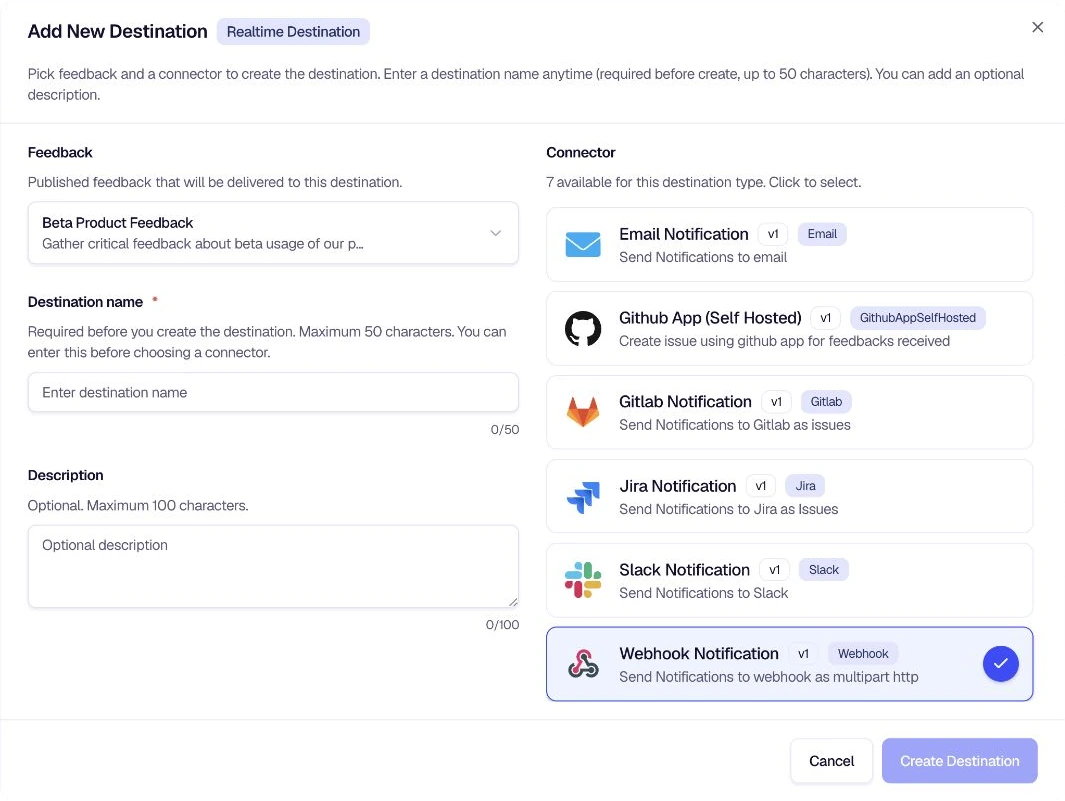
Then click Create Destination at the bottom of the modal to proceed.
Step 3: Configure Your Webhook Destination
After creating the destination, you'll land on the Edit Destination page. This is where you set up all the details that control how and where your webhook requests are sent.
Destination Details (Left Column)
On the left, you'll see cards for:
- Destination Details — Confirm the type (e.g., Realtime) and any high-level settings
- Feedback Configuration — The feedback form you linked in the previous step
- Connector Configuration — Shows "Webhook Notification" and its description
- Destination Name — Edit the name you gave earlier if needed (e.g., "Webhook")
- Destination Description — Edit the description if needed
Click Save Details when you're done with these fields.
Webhook Configuration (Right Column)
The right side is where the webhook-specific settings live. These are the settings encatch needs to send feedback to your endpoint.
Webhook URL
Enter the full URL of the endpoint that will receive the feedback. For example: https://api.example.com/feedback. encatch sends a POST request to this address whenever matching feedback is submitted. This field is required.
The description below the field explains: "The endpoint to which the webhook will be sent."
HTTP Method
The webhook destination uses POST for delivery.
Content Type
Choose application/json for JSON payloads or multipart/form-data when the destination needs file attachments. The editor warns that application/json does not support attachments.
HTTP Headers
If your endpoint requires custom headers (for example, an API key or authorization token), use the Add Item button to add key-value pairs. This section is optional—only add headers if your integration needs them.
Common use cases include:
- Authorization —
Authorization: Bearer your-api-key - Custom headers — Any headers your Zapier, n8n, or custom API requires
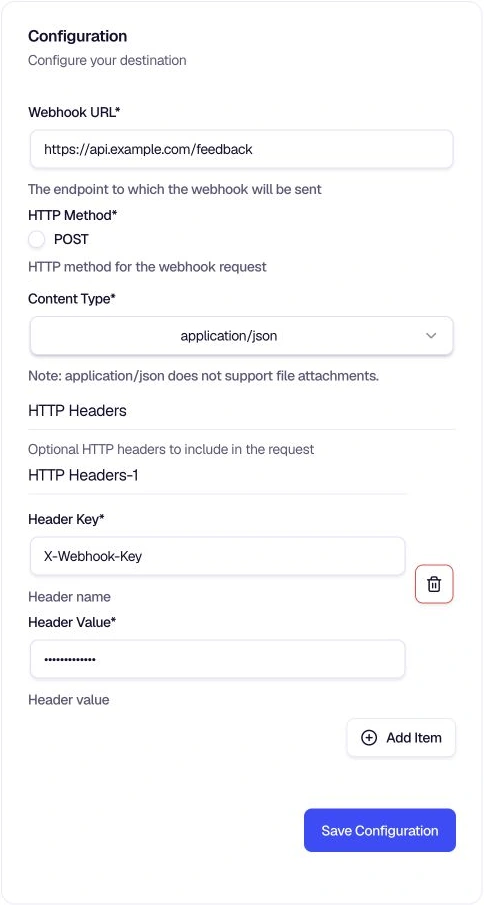
Click Save Configuration when you're done.
Step 4: Configure Filters (Optional)
Use Custom Filter for exact field-based conditions, or AI Filter when routing depends on the meaning of the response. Matching events continue to the webhook; non-matching events are not sent.
Click Test and Enable Custom Filter to build and validate a deterministic rule.
If you want to filter which feedback triggers a webhook, you can enable the AI Filter.
The AI Filter uses natural language prompts to decide which feedback should be forwarded. For example, you might only want to send webhooks for negative feedback, or for feedback that mentions specific keywords like "bug" or "urgent."
To enable it:
- In the AI Filter section, click Test and Enable AI Filter
- Configure your prompt to define the criteria
- Test the filter with sample feedback to ensure it behaves as expected
If you prefer to send every feedback response to your webhook without filtering, you can leave the AI Filter disabled.
AI Filters use AI Credits. Each execution consumes 1 AI Credit. See the AI Filters guide for more details.
Step 5: Test and Enable
Before going live, test your setup. On the Destination Status card, click Test & Enable Destination to verify your webhook URL works and that encatch can successfully send a test request. Once the test passes, the destination will be enabled and will start sending real webhooks for every new feedback response that matches your configuration (and any AI filter you've set up).
Summary
Here's a quick recap of the flow:
Go to Destinations — Click Add Destination on the Destinations page.
Select Webhook connector — Choose a published feedback form, add a destination name and optional description, then select Webhook Notification from the connector list and click Create Destination.
Configure webhook settings — Enter the Webhook URL, choose the content type, and add any optional headers. Delivery uses POST.
Optional: Add a filter — Use a Custom Filter for exact rules or an AI Filter for meaning-based routing.
Test and enable — Click Test & Enable Destination to activate your webhook.
Tips and Best Practices
- Use a descriptive destination name — Names like "Zapier Feedback" or "n8n Webhook" make it easy to identify integrations later.
- Verify your endpoint accepts the payload — Test with a tool like webhook.site or your service's test mode before enabling.
- Add auth headers when needed — If your endpoint requires authentication, use the HTTP Headers section to add your API key or token.
- Choose the right filter — Use a Custom Filter for exact conditions and an AI Filter when meaning or intent matters.
Troubleshooting
Was this page helpful?